
Beyond the Skin: Our Nervous System in a Living World
Nov 05, 2026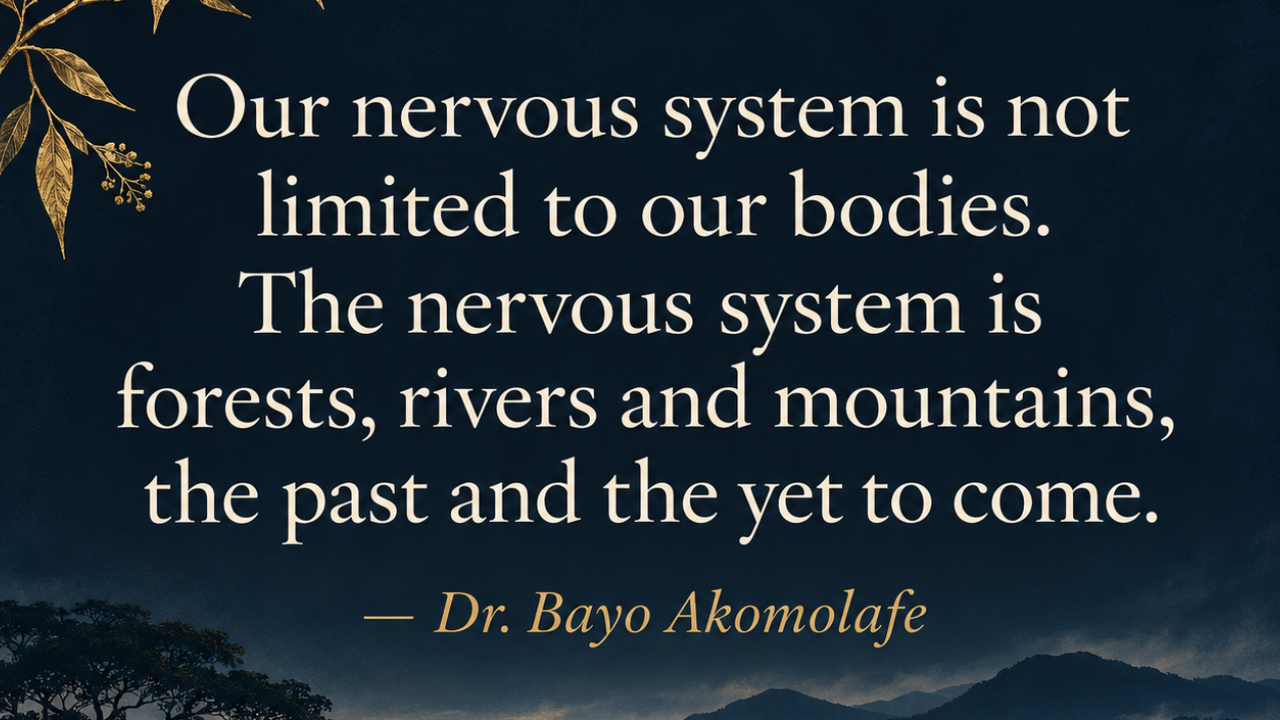
What Bayo Akomolafe invites us to reconsider about bodies, belonging and healing.
“Our nervous system is not limited to our bodies,” says Yoruba philosopher and psychologist Bayo Akomolafe. In the quotation shared by the documentary The Eternal Song, he goes on to include forests, rivers, mountains, the past and what is still to come.[1]
It is an arresting thought. We usually picture the nervous system as something contained within us: brain, spinal cord and branching nerves. How could a rainforest, a river or an ancestor be part of it?
My reading of Akomolafe’s words is that he is inviting us to reconsider where we believe a person begins and ends. His assertion belongs to a philosophical and relational understanding of life. Anatomically, rivers are not nerves and mountains are not parts of our brains. The invitation is to question whether anatomy alone can account for the life of a person.
What becomes visible when we understand ourselves through the relationships that make our lives possible?
A person is always becoming in relationship
In conversation with Thomas Hübl, Akomolafe challenges the image of the individual as an independent, finished entity. He describes personhood as an ongoing process, emerging within a world of relationships.[2]
This shifts the question from “How does the world affect an already separate me?” towards “How am I continually becoming through my encounters with the world?”
In his essay The Soul Is Not ‘Within’, he makes a related argument: identity and agency emerge through participation in a wider field of activity. The familiar distinction between an interior self and an exterior world conceals how thoroughly they are involved in one another.[3]
Through this lens, the forest is more than scenery surrounding a human life. We are participants in the living processes we usually call our environment.
Why forests, rivers and mountains?
Consider what makes this moment of being alive possible. There is the water you drink, the food you eat, the air you breathe and the conditions that make rest possible. There are places you recognise, sounds you know and people whose presence matters to you.
A landscape can also hold a person's livelihood, cultural responsibilities, memories and sense of home. A river might be where someone learned to fish with their grandmother, where their community gathers, and where their drinking water comes from. Its significance cannot be reduced to a pleasant sensory experience.
I understand Akomolafe’s provocation as asking us to include these relationships in how we think about ourselves. When a river is poisoned or a forest is destroyed, the loss reaches into the lives woven through that place. Caring for those lives requires attention to what is happening to the place itself.
That interpretation also changes the familiar invitation to “use nature as a resource”. We might begin to ask what responsibilities accompany the nourishment we receive. What does this waterway need? Whose care has sustained this place? What can we contribute?
Why the past; and the future?
The past is present through what it has made possible and what it has disrupted. Family stories, language, displacement, economic circumstances, institutions and cultural practices all have histories. We enter lives already shaped by them.
For someone separated from family or culture, belonging may involve questions that began before their birth. Who was permitted to remain together? Whose names were recorded? What was silenced? What connections remain available to renew?
These are ways of understanding how history participates in present life. They do not require a claim that detailed ancestral memories are biologically stored in us.
The future participates differently. An eviction notice, a threatened water supply or the promise of a secure home can change what today feels like. What we anticipate matters in the present. We also act in relation to people who will inherit the consequences of our choices.
My interpretation is that Akomolafe is widening the timescale of the self: we live within ongoing histories, and our lives reach towards possibilities and obligations beyond the present moment. This is a philosophical reading, rather than a claim that future events transmit signals backwards through time.
An example: a community and its river
Imagine a woman who has lived beside a river for most of her life. Her grandmother taught her its seasonal changes. Her children played along its banks. Friends meet there, and local families depend on it.
Now imagine that pollution makes the water unsafe. People stop gathering. Fishing ends. Arguments emerge about responsibility. She worries about her grandchildren and lies awake wondering whether the place she knows will recover.
An individual approach might focus on helping her manage anxiety and sleep. That support could be valuable. A relational approach would also ask what has happened to the river, the community’s shared routines and her expectations for the future.
Her distress has an ecology. It belongs to a situation involving water, family, memory, governance, uncertainty and loss.
A wider response might include practical support, places to grieve together, community participation in decisions, and action to restore the river. Her wellbeing and the wellbeing of the place have become impossible to neatly separate.
This imagined example is my illustration of Akomolafe’s perspective. The river is involved in the conditions through which her life becomes liveable; its injury cannot be addressed entirely within her body.
Moving from individualism towards relational responsibility
“Collectivist” captures part of this shift, particularly its attention to shared life. But Akomolafe’s perspective reaches beyond a human collective to include other beings, places and material relationships. “Relational” or “ecological” may therefore be more precise.
We can begin by changing the questions we ask:
-
Alongside “What is happening within me?” ask “What is happening around and between us?” Include relationships, working conditions, housing, culture and place.
-
Notice the support already making life possible. A meal, a public park, a friend’s time and clean water each have relationships and labour behind them.
-
Make care reciprocal. Learn about the places you depend on and support the people caring for them. Let attention become participation.
-
Share the work of making life liveable. Practical help, accessible spaces, fair workloads and community action belong within a wider understanding of care.
Akomolafe’s writing on slowing down challenges our habit of rushing to solutions while leaving the underlying framing untouched.[4] Here, slowing down might mean staying with a question long enough to discover that what looked like a private difficulty also has social, historical or ecological dimensions.
Relational responsibility still needs consent, boundaries and discernment. Communities can wound as well as sustain. A wider sense of belonging must leave room for difference and for leaving harmful relationships.
What this invites into therapeutic practice
For me, this perspective opens a useful question for Sandplay and somatic work: what relationships are asking to be recognised here?
A river appearing in a sand tray might carry personal associations, grief, cultural meaning or a longing for connection. Its meaning belongs to the maker and the unfolding process. We can remain curious about the person’s wider world without deciding in advance what a symbol represents.
Likewise, attention to bodily experience can sit alongside attention to the conditions a person returns to after a session. Therapeutic support and changes in those conditions can both matter.
Akomolafe’s words invite a larger field of care. We might begin with the body, then follow its relationships: towards the people who sustain us, the histories that shape us, the waters we depend on and the lives that will come after ours.
Perhaps the question to carry is this:
What becomes possible when caring for ourselves includes caring for the relationships that make us?
Sources and further reading
This blog offers an interpretation of Akomolafe’s work, with an original illustrative example. It distinguishes his philosophical perspective from anatomical claims about the nervous system.
-
The Eternal Song — the filmmakers’ website shares the quotation.
-
Bayo Akomolafe in conversation with Thomas Hübl: Bold Frontiers of Spiritual Healing — interview and transcript, 15 April 2025.
-
Bayo Akomolafe: The Soul Is Not ‘Within’ — 19 February 2022.
-
Bayo Akomolafe: The edges in the middle: A story about ‘We Will Dance with Mountains’ — 21 August 2017.
Author


